


Do Wood Stoves Pollute Indoor Air? How to Keep Your Home Safe
Wood stoves are one of the most efficient and satisfying ways to heat a home. They provide reliable heat during outages, they work well in off-grid setups, and they can be an excellent match for cabins and tiny houses. At the same time, indoor air quality concerns are real—especially in small, well-sealed spaces where airborne particles can build up faster than you’d expect.
So, do wood stoves pollute indoor air? Yes, they can. The good news is that the biggest risks are usually manageable with the right stove practices, good installation, and (when needed) a high-performance air purifier that can handle ultrafine smoke particles.
How wood stoves affect indoor air quality
Any combustion process creates byproducts. When you burn wood, the main indoor air concerns typically include:
- Fine particulate matter (PM2.5) from smoke and microscopic ash
- Smoke leakage during loading, start-up, or from worn seals
- Volatile organic compounds (VOCs) from incomplete combustion and odors
- Carbon monoxide (CO) risk if draft is poor or the system is malfunctioning
Even newer, cleaner-burning stoves can contribute to indoor particles under certain conditions—most commonly during loading, when draft is weak, or when fires smolder.
What is PM2.5 and why it matters
PM2.5 refers to particles smaller than 2.5 microns in diameter. These are tiny—far smaller than what you can see—and they’re a primary health concern with wood smoke. Because of their size, PM2.5 particles can penetrate deep into the lungs and may enter the bloodstream.
Short-term spikes may cause irritation (especially for sensitive people), while long-term exposure is associated in public health research with increased respiratory and cardiovascular risk. You don’t need to panic, but you also don’t want to ignore repeated indoor PM spikes over an entire heating season.
How PM2.5 gets into your home (even when you can’t see smoke)

Many indoor air issues from wood heat are subtle. You may not smell smoke, yet particle levels can still rise. Common causes include:
1) Loading the stove
Every time the door opens, a small amount of smoke and ultrafine particles can escape into the room. This is often the biggest PM spike in otherwise “good” stove setups.
2) Poor draft or negative pressure
Kitchen range hoods, bathroom fans, clothes dryers, or very tight construction can create negative pressure that competes with chimney draft. If you’ve ever had a puff of smoke roll out when opening the door, draft and pressure are prime suspects. If draft issues are a recurring problem, review these practical troubleshooting steps: understanding and solving chimney draft problems.
3) Leaky gaskets, joints, or connections
Door gaskets wear out. Stovepipe joints can loosen. Small leaks can release particles without any dramatic “smoke event.” Installation details matter more than people realize—especially in small homes. For pipe selection and layout basics, see: choosing the right wood stove pipe.
4) Smoldering fires and wet wood
Low-temperature burns and damp firewood increase smoke, VOCs, and fine particle output. Cleaner burning usually comes from burning dry wood hot and steady rather than trying to “stretch” a smoldering load overnight.
Smoke leakage: the invisible (and common) problem
A key point: the worst indoor exposure is often caused by invisible smoke particles, not thick visible smoke. In smaller spaces—tiny houses, cabins, well-insulated rooms—air volume is limited. A brief PM spike can linger and circulate longer than you’d expect, especially if windows stay closed in winter.
If you’re planning or upgrading a small-space heating setup, choosing the right stove for the space helps reduce operational issues that can contribute to smoke events. Related reads: best mini wood stoves and best wood-burning fireplace inserts.
Off-gassing and VOCs: not just “smoke smell”

Wood smoke contains volatile organic compounds (VOCs), especially when combustion is incomplete (smoldering, wet wood, restricted airflow). VOCs can contribute to odor and irritation, and they can also interact with other indoor chemistry to create secondary particles.
From a practical standpoint, the same habits that reduce smoke also reduce VOCs: burn dry wood, maintain strong draft, avoid long smolder phases, and keep the stove and chimney system in good shape.
Who is most at risk
Some people are more sensitive to smoke particles than others. Pay extra attention if your household includes:
- Children
- Older adults
- Anyone with asthma, COPD, or frequent respiratory irritation
- People with cardiovascular conditions
- Pets (especially birds)
If symptoms flare up during burning season, it’s a strong signal to tighten up stove practices and consider adding active particle control (more on that below).
How to reduce indoor pollution from a wood stove
Think in layers: reduce emissions at the source, prevent leakage, and then clean what remains.
1) Burn properly seasoned wood
Dry wood (generally under 20% moisture content) burns hotter and cleaner. If you’re deciding between species or wondering about performance, this is a useful reference: is ash good firewood?
2) Keep draft strong and stable
Draft problems are one of the most common causes of smoke roll-out and startup smoke indoors. If you’ve fought with this before, revisit: understanding and solving chimney draft problems.
3) Use correct clearances and safe installation
Safety and performance often go together. Correct clearances reduce overheating risks and help systems run as designed. Reference: clearance for wood stove safety requirements.
4) Maintain gaskets, seals, and connections
If you notice smoke odor during high burn or the door doesn’t seal tightly, check gaskets. Also inspect stovepipe joints and connections. A clean, properly assembled system is less likely to leak fine particles into living space.
5) Avoid long smolder burns when possible
Smoldering increases particles and VOCs. If you need long burn times, consider techniques that maintain cleaner combustion (proper loading, airflow management) rather than starving the fire too aggressively.
6) Understand your stove type tradeoffs
Different fuels and appliance types have different emission profiles and maintenance needs. If you’re weighing alternatives, see: wood stoves vs pellet stoves.
Why ventilation alone isn’t enough
Opening a window can dilute indoor pollutants, but in winter it’s not always practical—and outdoor air can also contain smoke in many areas. Ventilation helps, but it doesn’t capture particles; it just redistributes or dilutes them.
For many wood-heated homes, the most realistic approach is: burn clean + prevent leaks + filter the air.
Can an air purifier remove wood smoke indoors?
Yes—if it’s built for the job. Wood smoke contains a high percentage of ultrafine particles and PM2.5. Many standard “HEPA-style” devices are fine for dust and pollen but struggle with smoke-heavy conditions, especially in small homes where a single loading event can spike PM quickly.
To be genuinely helpful for wood smoke, an air purifier should have:
- Very high particle capture efficiency (including ultrafine particles)
- Enough airflow to cycle the room’s air multiple times per hour
- Carbon filtration for odor and VOC support (helpful, not mandatory)
- Real-time sensing so you can see spikes and respond
AirDoctor for wood-stove homes: a practical way to reduce PM2.5 exposure
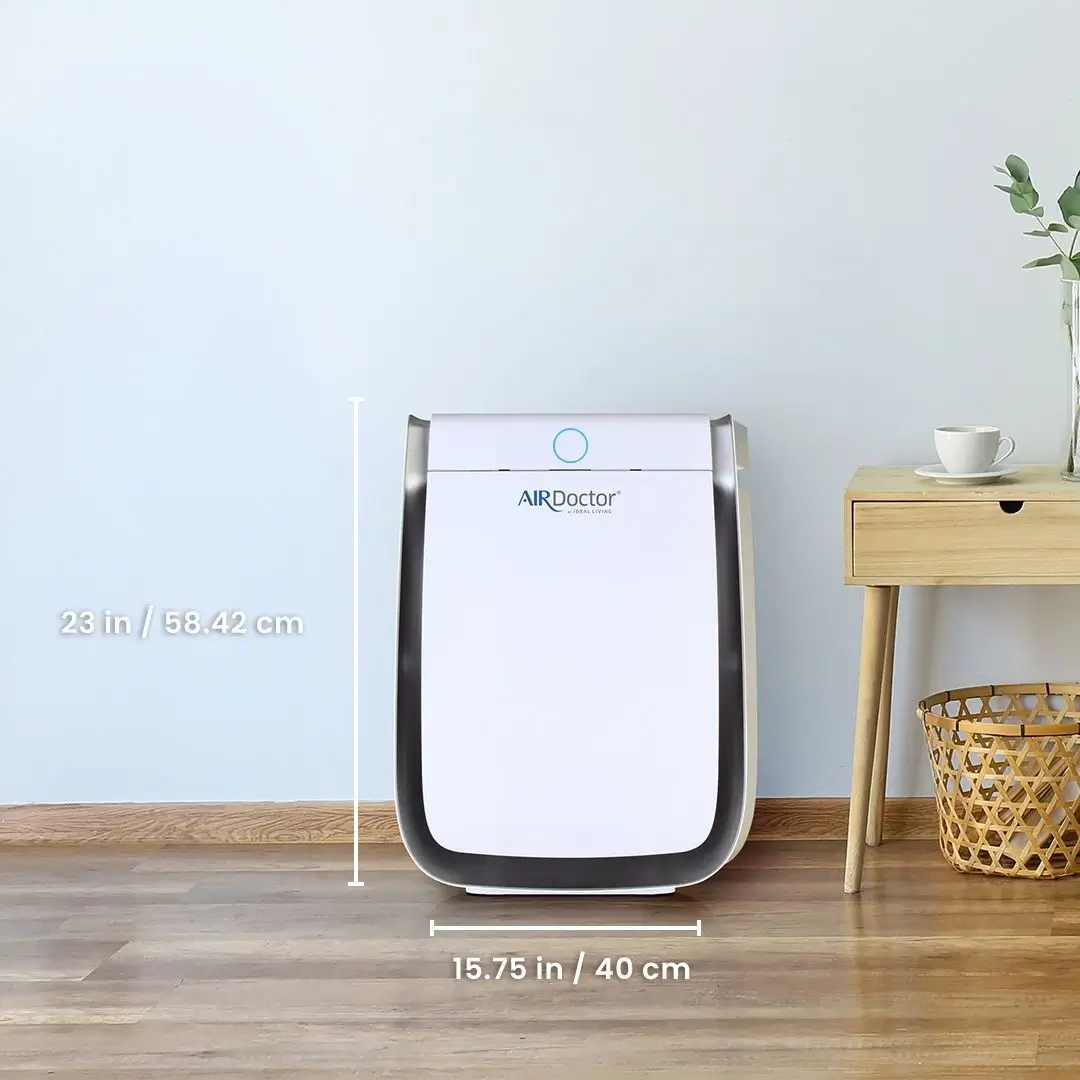
Not all air purifiers are capable of handling wood smoke effectively. If your goal is to reduce exposure to ultrafine particles—especially the invisible PM2.5 spikes that happen during loading and startup—filtration performance matters more than marketing labels.
AirDoctor is a strong fit for wood-heated homes because it’s designed around high-efficiency particle capture and practical day-to-day operation:
- UltraHEPA filtration that targets ultrafine particles well below the PM2.5 range
- High airflow to clean room air faster after loading events
- Carbon filtration that can help reduce smoke odors and VOC-related smells
- Air quality sensing so you can see when your stove routine causes spikes
If you’ve ever thought, “My stove seems fine, but the air feels heavy after loading,” that’s exactly the scenario where a purifier like AirDoctor can make a noticeable difference—because you’re not just dealing with visible smoke, you’re dealing with particles you can’t see.
Low-risk, high-impact use case: run the purifier continuously in the stove room during burn season, and temporarily increase fan speed during loading, startup, or when you notice a PM spike on the unit’s display (or on a separate air quality monitor).
If you want to check current AirDoctor options and specs, you can do it here: AirDoctor air purifiers (official site).
Placement tips for best results
- Place the unit in the same room as the stove (where spikes occur first).
- Keep it several feet from direct heat and away from the immediate loading path.
- Let it run on auto/low most of the day; turn it up during loading and start-up.
The bottom line: are wood stoves safe for indoor air?
Wood stoves are not inherently unsafe, but they are not pollution-free. The main indoor air risk is typically fine particles (PM2.5) released during loading, startup, draft issues, or smoldering fires. You can reduce exposure substantially by:
- Burning dry wood and avoiding smolder burns
- Maintaining strong draft and a tight, well-installed venting system
- Following clearance and safety requirements
- Adding a high-performance air purifier that can capture ultrafine particles
For many small-home and wood-heated setups, an air purifier is a practical “final layer” that helps keep indoor air cleaner without changing what you love about wood heat.
FAQ
Do wood stoves increase PM2.5 indoors?
They can. PM2.5 spikes often happen during stove loading, startup, poor draft, or smoldering fires. Even if smoke isn’t visible, ultrafine particles may still rise during these events.
Why do I smell smoke inside when the stove seems to be working?
Common causes include negative pressure (fans or tight construction), weak draft, leaky gaskets, or stovepipe connection issues. Draft troubleshooting and proper pipe selection can reduce these problems.
Is burning seasoned wood really that important for indoor air quality?
Yes. Dry, seasoned wood burns hotter and more completely, producing fewer particles and less smoke. Wet wood is more likely to smolder and spike indoor PM2.5.
Can an air purifier remove wood smoke particles?
Yes, if it has strong particle filtration and adequate airflow. Wood smoke contains a large amount of ultrafine particles, so filtration performance is critical.
Where should I place an air purifier if I heat with a wood stove?
Place it in the same room as the stove, several feet from direct heat, and run it continuously during burn season. Increase fan speed during loading and startup, when particle spikes are most likely.
Comments